
Otolith Atlas of Marine Fishes of Southern Africa and Adjacent Oceans
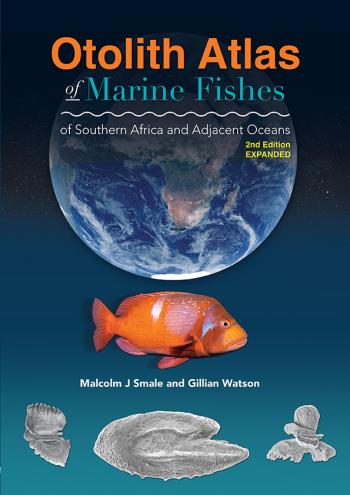
Second Edition – expanded
Size:
210x 297 mm
Pages:
696 pages
ISBN 13:
978-1-991458-02-5
Published:
December 2024
Publishers:
NISC (Pty) Ltd
Recommended Retail Price:
R485.00 inc. VAT
Cover:
Paperback
About the book
In this new edition, the Otolith Atlas of Marine Fishes of Southern Africa and Adjacent Oceans, authors Malcolm J Smale and Gillian Watson have expanded the coverage of the original benchmark work by Smale, Watson and Hecht (1995) to include almost double the number of species across a wider geographic area.
The 1 600 species whose otoliths are described here include not only fishes of the coastal waters of southern Africa but from farther afield, such as in the eastern Atlantic, western Indian Ocean and Southern Ocean. Detailed descriptions are supported by more than 4 000 scanning electron microscope images of individual whole otoliths, giving the reader easy access to otherwise fragile, rare or inaccessible reference material housed in local museum fish collections.
The Atlas will facilitate correct otolith identification, which plays a critical role in revealing predator–prey relationships, and allows for enumeration of the number, species and size of fish prey in stomach contents, scats or other prey remains. The authors of the Atlas have tabulated 782 length–length and length–mass regressions of 225 species, allowing researchers to calculate prey length and prey mass from measurements of otoliths obtained from stomach contents or middens. The often species-specific nature of otolith shapes or their similarity across members of the same genus or family, in both recent and extinct taxa, makes otoliths a useful tool in palaeoichthyology and the phylogenetic classification of bony fishes, including the discernment of species complexes. The descriptions and illustrations in the Atlas present copious reference material in this regard.
This Atlas constitutes an invaluable resource for fish species identification from otoliths by providing an innovative tool for ichthyologists and archaeologists, as well as fisheries scientists, ornithologists and mammalogists researching trophic interactions in marine and estuarine ecosystems. To facilitate access to the important information presented in this Atlas, the text, micrographs and regressions in this book are also available free for download from the publisher’s website.
Reviewers of the first edition said....
“For those studying fish predators or the paleontology of fishes off southern Africa, this atlas is a wealth of information. It is an overwhelming achievement considering the time and effort involved in describing, photographing, and measuring the number of specimens included in this atlas. Scanning through the plates was a treat...
JT Harvey and MM Yoklavich [published in Copeia, 1996(4), 1061–1063. https://doi.org/10.2307/1447685OTOLITH]
DOWNLOAD THE COMPLETE BOOK BELOW
Otolith Atlas TEXT only
Pages from Otolith Atlas PLATES 1-100
Pages from Otolith Atlas PLATES 101-200
Pages from Otolith Atlas PLATES 201_286