
Bettering their foods
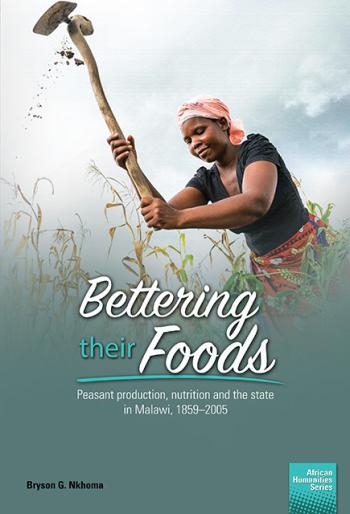
Peasant production, nutrition and the state in Malawi, 1859–2005
About the book
Despite the long history of agricultural interventions globally, peasants from Malawi and beyond continue to face the challenge of sustainable food production and nutrition. Bettering their foods: Peasant food production, nutrition and the state in Malawi, 1859–2005 weaves together the political, social, economic, demographic, climatic, ecological and global developments that have informed the various food production and nutrition interventions to account for this development. By bridging the late precolonial, colonial and postcolonial periods, the book presents the history of Malawi through the lens of peasant agriculture, covering important themes such as state formation, slave trade, Christian missions, the colonial state, urbanisation, immigration, trade, conservation, the two World Wars, nationalism and decolonisation, Malawi under Banda’s autocracy, African indigenous knowledge systems, rural development, and democratisation. The study, therefore, offers a critical textbook for undergraduate and graduate students of Empire, rural development, political transformations, economics, anthropology, and African history. For governments and NGOs, the book provides new insights into the dynamics of state interventions, food security, climate change, nutrition, gender, ecological change, and sustainable development. Unlike earlier studies, Bettering their foods contends that while capitalism disrupted local economies, it also made efforts (albeit limited) to transform African capacities to produce nutritious foods. The central drawback was that these efforts were mixed and limited by the derogatory attitudes the implementors had towards African practices. In making this argument, the study demonstrates the extent to which well-intended scientific projects are bound to fall short when providers fail to take into their equation the beneficiary communities, including their history, competitive interests and class diversities.
Reviewer’s Comments
This is an excellent book. It offers a very clear and cogent historical examination of the Malawian state's dispositions and imperatives regarding peasant agriculture as well as the state's shifting priorities regarding large-scale/small-scale (peasant) farming and food crops/cash crops … The work has a very smooth and uninterrupted flow, with the reader able to see how each chapter builds on the previous one in developing a comprehensive story of peasant food production in Malawi over time.
Professor Kirk Helliker, Department of Sociology, Rhodes University, Makhanda, South Africa
The author has put together a comprehensive study which is a useful intervention in the current period of uncertainty with development models. The peasants are depicted from the beginning as active – not just consumers of state policies. They have a logic or way of approaching issues which in most instances both the colonial and postcolonial states fail to acknowledge, leading to a collapse of many development initiatives. This is original work covering an important topic.
Dr Tendai Murisa, Executive Director, SIVIO Institute, Harare, Zimbabwe
Part of the African Humanities Series