
Wrecking Ball
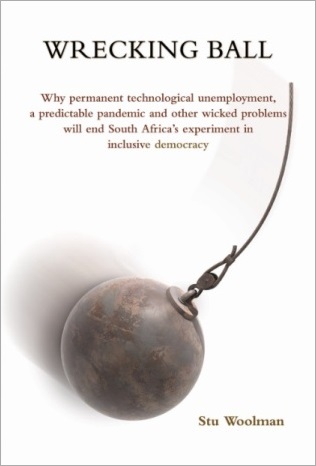
Why permanent technological unemployment, a predictable pandemic and other wicked problems will end South Africa’s experiment in inclusive democracy
About the book

Wrecking Ball explores, in an unprecedented manner, a decalogue of wicked problems that confronts humanity: Nuclear proliferation, climate change, pandemics, permanent technological unemployment, Orwellian public and private surveillance, social media that distorts reality, cyberwarfare, the fragmentation of democracies, the inability of nations to cabin private power, the failure of multinational institutions to promote collaboration and the deepening of autocratic rule in countries that have never known anything but extractive institutions. Collectively, or even severally, these wicked problems constitute crises that could end civilisation.
Wrecking Ball shows that without an inclusive system of global governance, the collective action required to solve those wicked problems falls beyond the remit of the world’s 20 inclusive democracies, 50 flawed democracies and 130 extractive, elitist autocracies. Flawed democracies and autocracies that already struggle to produce goods necessary for their own citizens to flourish, are simply incapable of committing to international arrangements that address the existential threats posed by the decalogue of wicked problems.
Wrecking Ball offers, as an answer, a ground-breaking analysis of South Africa’s political economy. It demonstrates that this country’s elitist and extractive political and economic institutions not only make resolution of ongoing domestic crises unattainable, likewise, they make meaningful responses to wicked problems impossible.
Wrecking Ball similalry operates under no such ‘smart’ pretenses, and undeterred and unmatched ventures into terrrains traversed by truly great political economists: Smith, Ricardo, Marx and Keynes. By knitting together what we all know to be the facts, with cutting edge theory in economics, sociology, history and political science, the book paints an unflinching portrait of where we are, and where we are headed.
‘[Woolman] marshals a wealth of evidence in support of his argument and has clearly digested and synthesised a very wide range of literature. Indeed, the book reads in part like a modern-day version of the great 18th century works of political economy’.
Professor Theunis Roux, School of Global and Public Law, University of Sydney