
Breeding Ecology of the Madagascar Grebe Tachybaptus pelzelnii

Posted 27 March 2025 by under Announcements & Notices • Journal: Ostrich: Journal of African Ornithology
Breeding Ecology of the Madagascar Grebe Tachybaptus pelzelnii
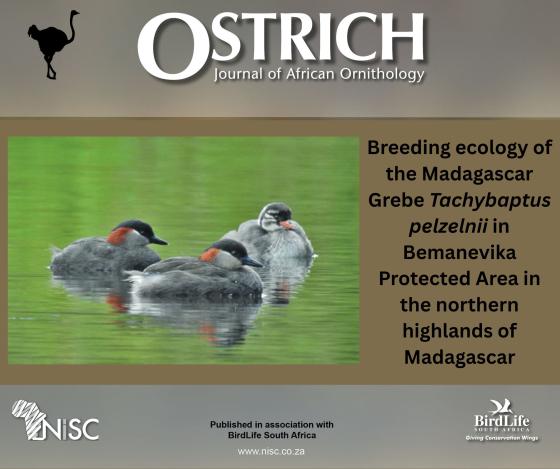
In Madagascar’s wetlands, the birds of this region stand out as the most studied animal group, with these wetlands serving not only as habitats for breeding, feeding and a place of rest for resident migrant species, but also as refuge for many migratory species.

The loss of Madagascar’s wetlands has become a major concern because of its impact on biodiversity, with the wetlands of the Bemanevika Protected Area (BPA) in the Northern Highlands of Madagascar comprising of lakes, marshes, and rivers, covering an area of 10 000 hectares. 

Grebes are a quintessential aquatic group, with its members adapted to live on and under water. In Madagascar, this family is represented only by three species of the genus Tachybaptus: Little Grebe Tachybaptus ruficollis, Madagascar Grebe Tachybaptus pelzelnii, and Alaotra Grebe Tachybaptus rufolavatus. After the confirmed extinction of the Alaotra Grebe in 2010, the Madagascar Grebe remains the only endemic grebe species in Madagascar, and was classified as endangered since 2018 because of habitat loss due to decreasing quality and increasing disappearance of wetlands and intense fishing activity. 

Ostrich Journal of African Ornithology 2025, Volume 96, Issue 1 includes an article titled “Breeding ecology of the Madagascar Grebe Tachybaptus pelzelnii in Bemanevika Protected Area in the northern highlands of Madagascar”. The study explored the ecology of this Grebe over two consecutive years (October 2020-September 2022). 

Two breeding units were observed: pairs and trios made up of one male and two females. The evidence supported polygyny, over communal breeding, for the trios — the first record for the family.  Researchers counted 147 occupied nests, of which 105 were monitored during the two breeding seasons: 78 nests with pairs and 27 nests with trios. Breeding activity occurred from October to April, with nest construction lasting on average 21.4 days. 

This study provides new information on several aspects of the breeding biology of the endangered Madagascar Grebe, with the results providing baseline information that is essential for any strategies aimed at improving the conservation status of the species. 

This article can be read at no cost until the end of June 2025 here


The proofs look great! Thank you so much. The efficiency of the journal now is really excellent. Easy to work with, and so thorough. I appreciate it.
- Regular SAJP Author on his first interaction with NISC
The biggest development in the history of Quaestiones Mathematicae was the association with NISC and to have the journal running in a very stable way without severe financial concerns.
- Barry Green, QM Editor
It has been an enriching experience working with such enthusiastic and professional people at NISC who have become more friends than business partners over the years.
- Stan Pillar, Editor of the African Journal of Marine Science (1996-2013)
The NISC partnership has benefited the Indo-Pacific Journal of Phenomenology by bringing sustainability, additional branding and marketing, a wider reach through its websites, and the added value of expertise in the very competitive world of publishing.
- Chris Stones, IPJP Editor-in-Chief since 2003
Thank you for the rare experience of a set of proofs on which I can find nothing to correct!
- SAJP author from Florida Atlantic University
Perhaps the most important change, in terms of bringing the Journal to a wider audience, has been its publishing in collaboration with the NISC (Pty) Ltd.
- Stan Pillar, Editor of the African Journal of Marine Science (1996-2013)
Since 1995, NISC has systematically built up competence and the necessary capacity in all aspects of publishing high-level research journals, with the professionalism needed to flourish in the increasingly competitive world of international research publications. No other publisher in South Africa commands the necessary technical skills, experience, competence, enthusiasm and resources to the same degree as NISC, in my view.
- Graham Baker, Editor of the South African Journal of Science (1973-2008)
The review process is quick and is being done within the reasonable time. After acceptance, NISC is also quick enough to send proofs and is very efficiently publishes the accepted paper online before its print version.
- Author - Southern Forests: A Journal of Forest Science
The paper was wonderfully laid out and rapidly published
- Author- Ostrich: Journal of African Ornithology
Excellent attention by editor-in-chief; very good work of reviewers; good time for review and processing.
- Author - African Journal of Range & Forage Science
The editorial experience was excellent: the reviewers were timely and their feedback was generative. The co-editor of the special issue was proactive about communicating information to me. In latter stages, the staff that shepherded the essay through the copy-editing stages was also very helpful and in good contact.
- Author - Eastern African Literary and Cultural Studies
A very supportive, personal and committed editorial team, which takes quality of the work very seriously. I learned a lot through the experience of publishing with Anthropology Southern Africa, and felt supported throughout the process.
- Author - Anthropology Southern Africa