
Polychaete Special Issue Call for Papers & Photographs
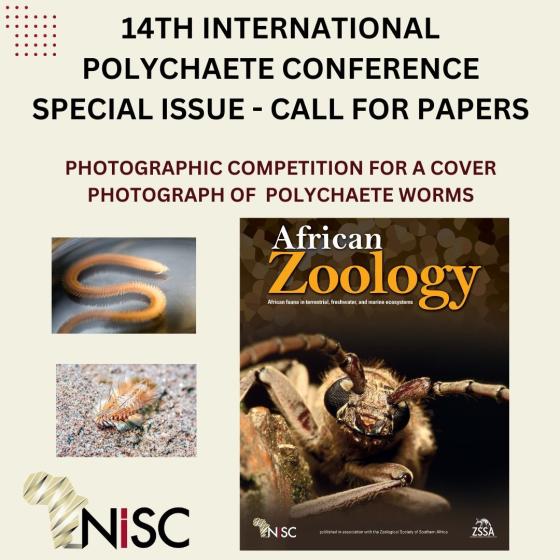
A Special Issue coming out of the 14th International Polychaete Conference will be published in African Zoology in April 2024.
The call for abstracts for the Special Issue is now open, with there being two rounds of abstract submissions for the conference to accommodate attendees who need to apply for funding (details on the conference submission portal) or get approval for travel from their institutions.
The conference will take place between the 3-7 July 2023 in Stellenbosch.
Abstracts are invited under the following themes:
Invasive species; Economically important species (pests/bait species); Education; Systematics and phylogenetics; Taxonomy and morphology; Physiology and ecology and Developmental morphology.
Abstracts can be submitted here with further information regarding the length of abstracts and intructions for authors listed.
A Polychaete worm photography competition is being hosted, with the winning photograph being featured on the African Zoology Special Issue cover. To submit your photograph/s please email them to Sarah Avis at NISC here.
Key Dates:
▪ 28 February 2023 - First round of abstract submissions
▪ 13 March 2023 - Abstract status notifications
▪ 31 March 2023 - Final round of abstract submissions
▪ 20 April 2023 - Abstract status notifications
▪ 30 September 2023 - Final submission of papers to African Zoology to be considered
African Zoology, a peer-reviewed research journal, publishes original scientific contributions and critical reviews that focus principally on African fauna in terrestrial, freshwater, and marine ecosystems. Research from other regions that advances practical and theoretical aspects of zoology will be considered. Rigorous question-driven research in all aspects of zoology will take precedence over descriptive research. The journal publishes full-length papers, critical reviews, short communications, letters to the editors as well as book reviews. Contributions based on purely observational, descriptive or anecdotal data will not be considered.